
Client Profile
A global telecommunications company with a long history of R&D investment had built a substantial patent portfolio over many years. While the portfolio covered multiple telecom and adjacent technologies, it was largely treated as a cost center. Licensing activity was limited, and decision‑makers lacked a consolidated view of where real value existed across the portfolio.
The company had previously worked with several vendors, primarily focusing on categorization and isolated licensing opportunities. However, these efforts failed to provide a clear, portfolio-wide monetization strategy or a fact-based narrative to support investment decisions at the executive level.
Business Challenge
The client faced three interconnected challenges:
- Lack of visibility into portfolio value
Senior management did not have a clear understanding of the patent portfolio’s value, how different patents could be monetized, or which assets warranted further investment. - Missed monetization and standard‑related opportunities
Although the company participated in patent pools, only a limited subset of patents had been declared. Potential additional pool declarations and bilateral licensing opportunities were not systematically explored. - Rising portfolio maintenance costs
The company continued paying annuities across a large volume of patents without clarity on which assets contributed to revenue generation, strategic positioning, or risk mitigation.
The client needed a credible, data‑driven blueprint that could translate a complex patent estate into clear business decisions: where to invest, where to monetize, and where to prune.
Our Approach
We designed a holistic licensing and monetization blueprint covering the entire patent portfolio, rather than isolated high‑value filings.
- Portfolio‑wide review and structuring
A dedicated team conducted a comprehensive review of the patent estate and organized the portfolio across four complementary dimensions:
- Technology domains (e.g., telecom infrastructure, connectivity‑related innovations)
- Application and product areas (e.g., mobile devices, video communication platforms, IoT, automotive use cases)
- Target companies with potential exposure to the patented technologies
- Relevant patent pools and standards ecosystems
This multidimensional structure enabled the client to see the same patents through different commercial and strategic lenses.
- First‑pass licensability assessment
Each patent underwent an initial, high‑level licensability review focused on:
- Breadth and clarity of claims
- Feasibility of demonstrating infringement
- Availability of technical documentation to support future evidence‑of‑use analysis
This was intentionally framed as a directional assessment, allowing the client to prioritize assets before committing to more in-depth, cost‑intensive legal work.
- Portfolio valuation analysis
For each licensing package, we conducted market research to estimate:
- Size of the relevant addressable market
- Adoption of the patented technologies within products or standards
- Potential licensing income ranges by package
These estimates helped translate patents from legal artifacts into business‑relevant economic indicators.
- Patent Portfolio Value Optimization Plan
Each patent, or patent cluster, was mapped to a clear next step:
- Detailed standards essentiality assessment
- In‑depth infringement analysis and evidence‑of‑use development
- Patent pool declaration review
- Cost‑saving pruning or annuity reduction opportunities
Our Approach
The client received a clear, executive‑level blueprint that answered three critical questions:
- What do we own?
A structured, portfolio‑wide view of technologies, applications, targets, and standards relevance. - What is it worth?
Data‑supported estimates of monetization potential across different licensing packages. - What should we do next?
A prioritized set of actions linking patents to revenue generation, cost reduction, or strategic positioning.
For the first time, the patent portfolio could be discussed internally, not just as a legal necessity, but as a measurable business asset. The blueprint enabled informed conversations with senior leadership around further investment, portfolio optimization, and go‑to‑market licensing strategy.
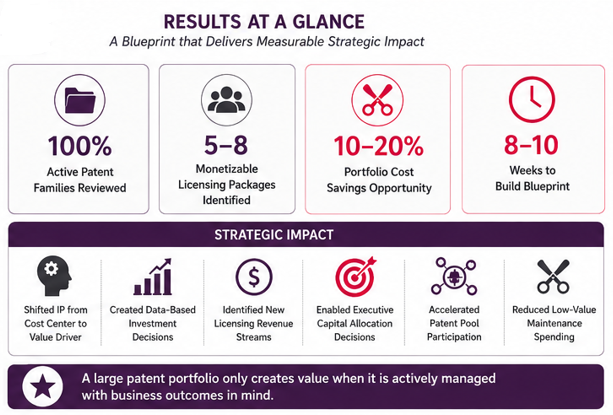
Strategic Impact
- Shifted IP perception from cost center to value driver
- Created a defensible business case for further monetization investment
- Identified both new revenue opportunities and annuity cost savings
- Established the foundation for a lean, value‑focused IP strategy
Key Takeaway
A large patent portfolio only creates value when it is actively managed with business outcomes in mind. By combining portfolio‑wide analysis, market insight, and clear action paths, the client gained the clarity required to move from passive ownership to intentional monetization.
Talk to One of Our Experts
Get in touch today to see how Evalueserve can help you unlock the full licensing potential of your IP portfolio.
