This blog builds on the introductory perspective shared in “TFA in Focus: What You Need to Know.” If you are looking for the strategic overview for non-scientists, refer to it. The analysis below presents the technical, regulatory, and scientific details relevant to environmental, regulatory affairs, and chemical safety experts.
Executive Summary
Trifluoroacetic acid (TFA), the terminal degradation product of numerous fluorinated substances, has shifted from a peripheral environmental finding to a central concern in European chemical policy. Its extreme persistence, high mobility, and expanding detection across water systems and agricultural environments have positioned it at the forefront of PFAS-related regulatory debates.
Recent monitoring demonstrates the widespread occurrence of TFA across Europe. EFSA’s proposed acceptable daily intake (ADI) of 0.03 mg/kg bw/day has intensified discussions among regulators, NGOs, member states, and industry stakeholders. The implications span chemical manufacturing, agrochemicals, pharmaceuticals, water utilities, and downstream users.
TFA is now a pivotal issue in Europe’s PFAS regulatory evolution, requiring updated exposure models, robust monitoring frameworks, and proactive compliance strategies.
What Is TFA? (Technical Definition)
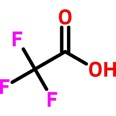
TFA (CF₃COOH) is an ultra-short-chain PFAS formed as the final oxidative or degradation product of thousands of fluorinated substances, including:
- HFO refrigerants (e.g., R-1234yf used in HVAC and automotive systems)
- HFCs
- Fluorinated pesticides
- Fluorinated pharmaceuticals
- Fluoropolymers and specialty chemicals
Its molecular structure—with a strongly bonded trifluoromethyl group—confers exceptional resistance to hydrolysis, photolysis, and biodegradation. This makes TFA both persistent and mobile across environmental compartments.
Why TFA Is Becoming a Central Regulatory Priority
Extreme persistence
TFA is effectively irreversible under natural environmental conditions.
High mobility
Its polarity and solubility allow it to rush through surface water, groundwater, and atmospheric pathways.
Rising detection levels
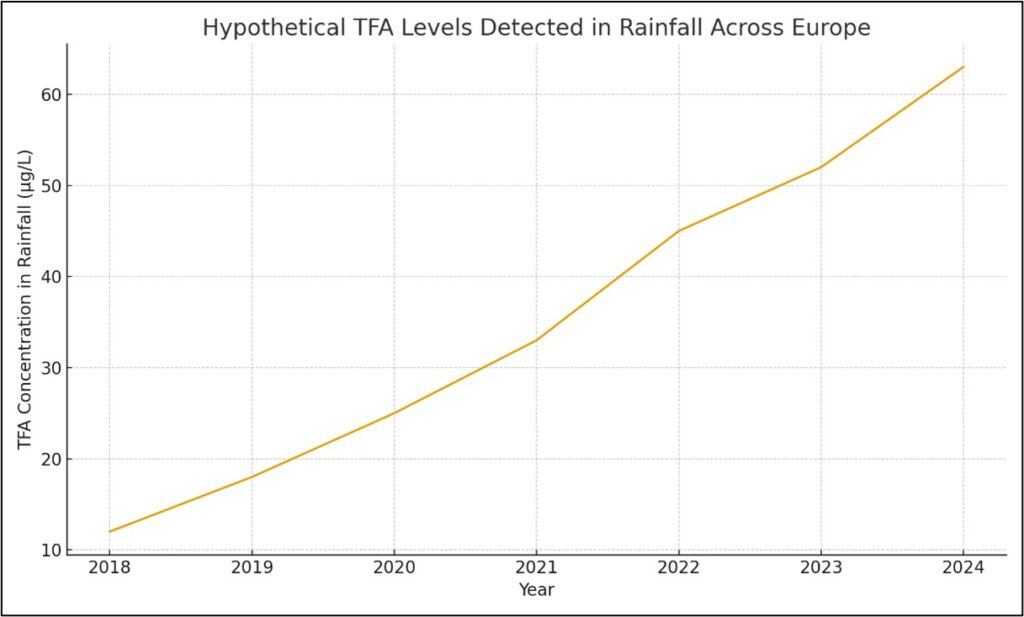
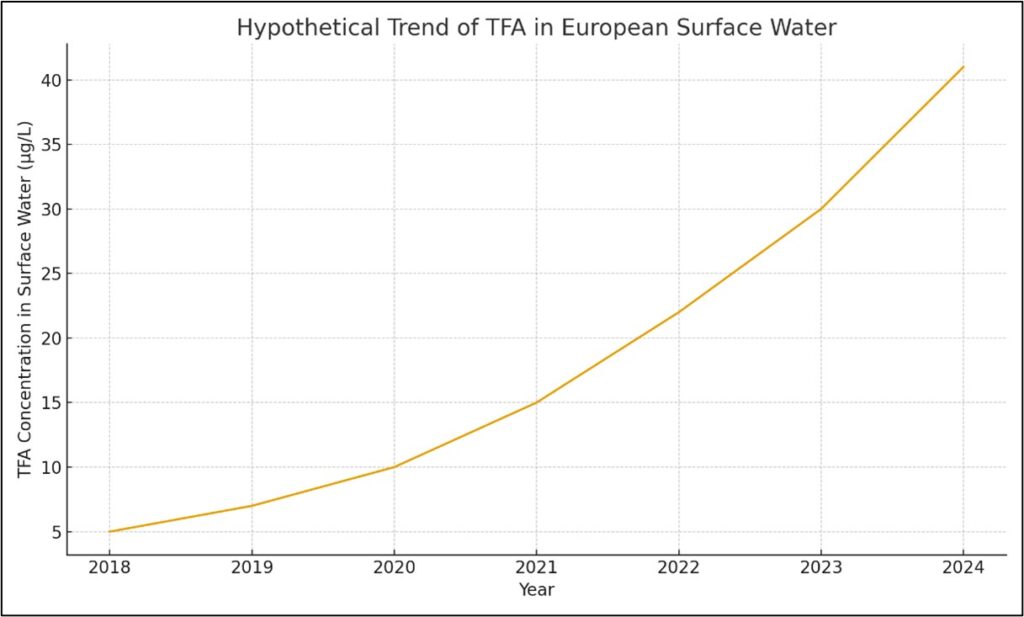
Monitoring programs across Europe increasingly detect TFA in rainfall, drinking water, and agricultural samples.
Toxicological uncertainties
Emerging evidence indicates developmental and liver toxicity, prompting precautionary assessments by EFSA.
Planetary-boundary relevance
Recent analyses suggest TFA may contribute to “novel entities” pressures due to irreversible global accumulation.
These characteristics make TFA a priority in the next phase of PFAS policy development.
These concerns also align with the European Chemicals Agency’s PFAS Restriction Proposal, which identifies persistent and mobile PFAS—including TFA—as substances that warrant broad risk-management consideration.
The Exposure Landscape: Data and Evidence
Atmospheric deposition
Measured median concentrations include:
- 0.29 μg/L (USA)
- 0.21 μg/L (Germany)
- 0.70 μg/L (Fuxin, China)
Drinking-water occurrence
PAN Europe’s 2025 assessment detected TFA in 94% of drinking-water samples across 11 countries.
Food and agriculture
TFA levels in European wines have increased significantly in post-1980s vintages, correlating with increased use of fluorinated pesticides and refrigerants.
These datasets confirm that TFA exposure is now widespread across environmental and agricultural systems.
Key Scientific and Regulatory Concerns
|
Category
|
Description
|
Relevance
|
|---|---|---|
|
Persistence
|
Resistant to degradation
|
Supports PFAS-restriction frameworks
|
|
Mobility
|
Moves readily through water
|
Requires water-quality monitoring
|
|
Formation pathways
|
Generated from HFOs, HFCs, pesticides, and pharmaceuticals
|
Complicates source attribution
|
|
Toxicity
|
Indications of developmental and liver impacts
|
Drives conservative ADI proposals
|
|
Broad detection
|
Found across Europe
|
Indications of developmental and liver impacts
|
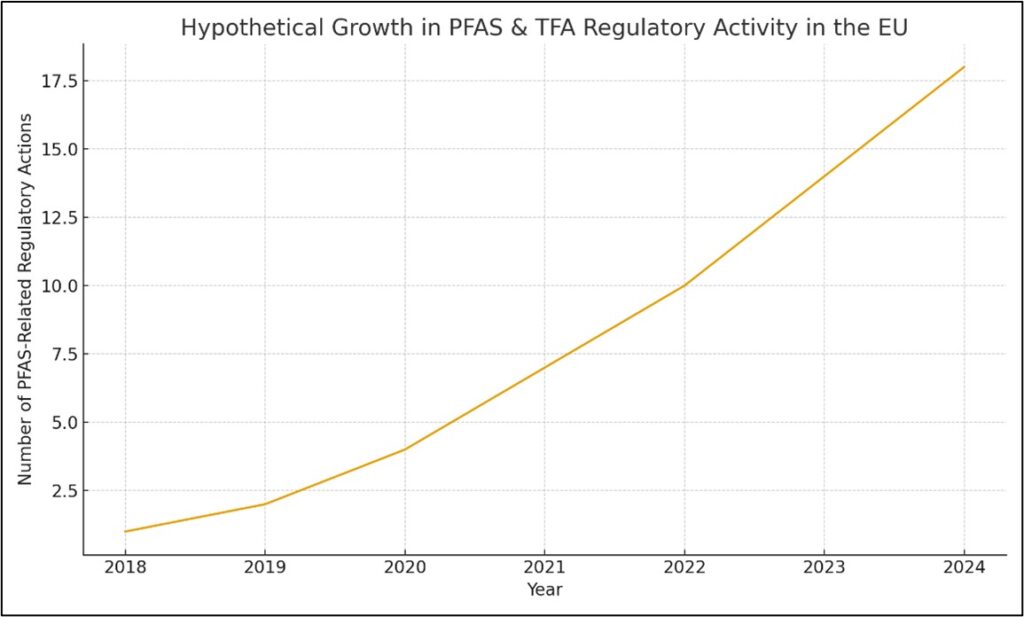
The Role of PFAS Regulatory Acceleration
TFA is indirectly shaped by broader PFAS regulatory pressure, including:
- EU Chemicals Strategy for Sustainability
- REACH PFAS Restriction Proposal
- National drinking-water initiatives
- NGO campaigns and media focus on PFAS exposure
These frameworks are increasingly aligning with TFA’s environmental presence and toxicological profile.
EFSA’s ADI Proposal and the Regulatory Debate
EFSA’s proposed ADI of 0.03 mg/kg bw/day has sparked polarized responses:
Regulatory and NGO viewpoints:
- Widespread exposure warrants precaution
- Regulatory thresholds must reflect irreversible accumulation
- Protective guidance values are justified given uncertainties
Industry perspectives:
- Environmental concentrations remain low relative to proposed limits
- Toxicology models rely on conservative assumptions
- Stringent limits may challenge climate-driven refrigerant transitions
- More data is needed before finalizing ADI levels
This ongoing debate will influence upcoming drinking-water values, food residue limits, and industrial reporting obligations.
Sector-Specific Implications
Chemical manufacturers
Must evaluate TFA formation across product portfolios and disclosure obligations.
Pharmaceutical & agrochemical industries
TFA must be considered in environmental fate, metabolism, and risk-assessment frameworks.
Water utilities
Face monitoring expansion despite limited feasible removal technologies.
Food and beverage producers
May encounter evolving residue-limit requirements.
Regulators
Must refine toxicology benchmarks, harmonize national standards, and clarify source-attribution processes.
The Treatment Challenge
TFA’s chemical properties make it resistant to:
- activated carbon
- ozonation
- advanced oxidation processes
Reverse osmosis is more effective but cost-intensive. This creates a gap between the ambition of precautionary policy and the available treatment capabilities.
Strategic Recommendations
- Expand monitoring across water, effluents, and supply chains.
- Map formation pathways for TFA-generating substances.
- Integrate TFA into PFAS risk frameworks and ESG reporting.
- Prepare for lower thresholds by engaging in EU and national consultations.
- Increase supplier transparency on PFAS degradation profiles.
- Align internal communication with regulatory trends and stakeholder expectations.
Talk to One of Our Experts
Get in touch today to find out about how Evalueserve can help you improve your processes, making you better, faster and more efficient.