Technology Intelligence for R&D and IP: Why the Mind + Machine Model Is Winning

In R&D and IP, the difference between shaping the market and chasing it is often just one decision cycle. The organizations that consistently lead are those that invest in R&D for technical advancement, not those that merely collect more information. This creates a void in decision readiness: teams have information, but not enough time to convert it into action. That urgency is showing up in the volume of signals leaders must interpret. In 2023, global patent filings reached about 3.55 million applications, a record level. As activity rises, so does the complexity of identifying what’s truly novel, strategically relevant, and actionable  

Consumer robotics offers a recent illustration of this risk. A company that pioneered autonomous vacuum technology and defined the category struggled to respond as competitors adopted new navigation methods and integrated features more quickly, ultimately losing market leadership and filing for bankruptcy in 2025. 

The implication is straightforward: technology intelligence can’t remain a periodic exercise. It has to function as a decision system, continuously scanning across patents, scientific literature, market moves, and regulatory cues, then translating that noise into prioritized choices for where to invest, how to protect, and when to partner. In practice, this sits at the intersection of IP and R&D leadership: decisions about where to file, where to seek whitespace, how to manage risk, and which technology paths deserve sustained investment. 

This is where the Mind + Machine model becomes practical. AI expands coverage and speed, while human experts provide context and validation when the decision carries real strategic or legal consequences.  

When technology intelligence becomes a leadership advantage 

Market leaders don’t wait for trends to become obvious; they act when the signals are still weak but credible. Think of a competitor that quietly starts filing in a niche you considered peripheral; by the time it shows up in headlines, they already hold a meaningful position in that patent space.  

In AI computing, Nvidia’s early focus on GPU acceleration and supporting IP laid the groundwork for its current dominance, while others recognized the strategic implications only after demand had sharply shifted. 

This is where technology intelligence becomes less about producing an occasional report and more about protecting strategic timing. The question isn’t “Can we analyze this?” It’s “Can we analyze it early enough to change the outcome?” The best programs use technology intelligence to reduce three recurring risks:  

  • False confidence: acting on a clean narrative that isn’t well supported  
  • Late certainty: waiting for perfect validation and missing the window  
  • Fragmented view: treating patents, papers, market signals, and regulation as separate worlds  

For IP leaders, that fragmentation can translate directly into missed whitespace, crowded claim territories, or portfolios that are misaligned with where the technology is actually moving.  

(simplify) There’s also a complex economic backdrop: R&D is a major investment for most companies. Globally, R&D spending is about 2.67% of world GDP (2022), and it’s even higher in many advanced economies. When that much is at stake, slow or uncertain decisions have real costs: wasted spend, delayed course-corrections, and avoidable risk. When the investment is that material, the cost of slow or shaky decisions isn’t theoretical; it shows up in wasted bets, delayed pivots, and avoidable risk.  

AI helps with what used to slow everything down: scanning broadly and surfacing patterns across large bodies of information. But the make-or-break step is what happens next, because strategic choices hinge on which signals are actually material and what they imply for investment, partnerships, and IP posture.   

Why “platforms” alone don’t win, operating models do

If AI is so powerful, why do so many organizations still struggle to turn it into a consistent strategic advantage? One reason is that most implementations prioritize tools over trustBCG’s research found that only 26% of companies have built the capabilities to move beyond proofs of concept and generate tangible value from AI. The gap is rarely ambition. It is execution: weak governance, unclear ownership, and outputs that decision-makers can’t confidently act on.  

This is where technology intelligence needs an operating model, not just automation. Gartner predicts that by 2026, more than 80% of enterprises will have used GenAI APIs/models or deployed GenAI-enabled applications in production, up from less than 5% in 2023.  

As generative AI adoption becomes mainstream, differentiation in TI no longer comes from speed of discovery alone, but from how quickly weak signals are verified, how rigorously insights are curated, and how clearly implications are framed for action. The competitive edge lies in blending velocity with validation, and breadth with accountability. 

At Evalueserve, that blend is intentional. Our Mind + Machine approach treats human + AI expertise as the default design: AI accelerates scanning and synthesis, and human experts validate what’s decision-critical and translate signals into clear strategic implications. That’s how it becomes usable at the leadership level, not just impressive at the demo level.  

The result is technology intelligence that is not just faster, but more decision-ready, built for the pace at which the landscape now moves.  

QuickLens Methodology: Human-Guided AI for Technology Intelligence

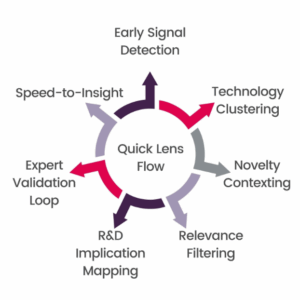
QuickLens blends AI-led scanning and synthesis, with the option to add subject-matter expert validation, depending on how high-stakes the decision is.   

Here’s how the Mind + Machine flow typically plays out:  

  1. Early-stage technology signal detection (pre-market) 
    QuickLens is designed to surface weak and early technical signals from patents, scientific publications, and technical disclosures, well before technologies translate into products, revenues, or market share. This positions it squarely upstream of traditional TI. 
  2. Technology-centric clustering, not company-centric tracking 
    AI in QuickLens clusters information around technical concepts, mechanisms, and architectures, rather than around companies or products. This enables TI teams to understand how a technology is evolving, not just who is active. 
  3. AI-accelerated prior-art and novelty contexting 
    QuickLens rapidly maps emerging ideas against existing patents and publications, helping TI teams assess technical novelty, maturity, and differentiation potential, a core requirement for R&D, IP strategy, and innovation planning. 
  4. Signal validation through technical relevance filters 
    Unlike TI tools that optimize for coverage, QuickLens applies AI filters aligned to technical feasibility and relevance, reducing noise and allowing TI teams to focus on signals that can realistically impact technology roadmaps. 
  5. Translation of technical signals into R&D implications 
    Outputs are structured to answer TI-specific questions such as: 
  • Is this technology incremental or discontinuous? 
  • Is it lab-stage, prototype-ready, or scaling? 
  • Where does it intersect with our existing capabilities? This bridges the gap between raw technology data and actionable R&D decisions.

Human-in-the-loop validation for decision-critical insights 
QuickLens embeds expert review where it matters most, interpreting ambiguous signals, assessing technical credibility, and flagging over-hyped or non-scalable technologies. This is essential for TI, where false positives are costly. 

Built for speed-to-insight in fast-moving technology domains 
By compressing weeks of manual technology scouting into days, QuickLens enables TI teams to sense, validate, and respond to emerging technologies at the pace required for modern R&D and innovation cycles.
 

From signals to strategy

The pace of change in R&D and IP isn't slowing, so decision-making can’t afford long cycles or shaky inputs. The practical answer is, QuickLens, a model that pairs AI’s scale and speed with human judgment and validation, especially where the stakes are high.  

A good way to start is simple: apply this approach to one live priority, such as a technology landscape assessment in a critical domain and use the outcome to set a faster, more reliable rhythm in the future. 

Start with a focused QuickLens engagement on a live prioritysuch as a competitor watchlist or technology landscape assessment, so your next strategic decision is based on clearer, more timely insight. Let’s talk! 

Talk to One of Our Experts

Get in touch today to find out about how Evalueserve can help you improve your processes, making you better, faster and more efficient.  

Written by

Manav Garg
Product Manager

Latest Posts