How Japan's F&B Giants Are Going Abroad
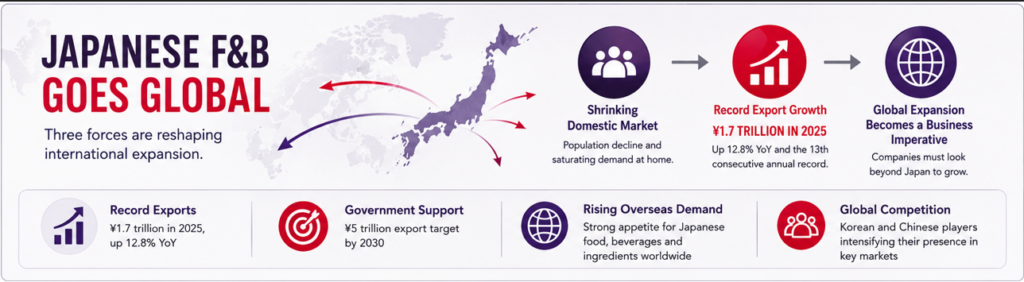
For decades, Japan's food and beverage companies grew by feeding Japan. That calculation has changed. With a shrinking population and a saturated home market, international expansion has moved from a strategic option to an operational necessity — and the industry's leading players are showing, in real time, how that shift is executed.
A Market Turning Outward
Japan's agricultural, forestry, fishery, and food exports hit a record ¥1.7 trillion in 2025, up 12.8% year-on-year and the country's thirteenth consecutive annual record. The United States was the top destination, with shipments up 13.7%. The government has set a ¥5 trillion export target for 2030 — a goal that will require Japanese F&B companies to keep pushing well beyond their home market's shrinking demand base.
Matcha: A Cultural Ingredient Goes Global
No ingredient shows the opportunity more clearly than matcha. Estimates vary by research house, but the global matcha market was worth roughly $4–5 billion in 2024–2025 and is on track to roughly double by the early 2030s. Two Japanese companies illustrate the two ways to capture that growth. ITO EN, Japan's largest tea producer, has moved up the value chain from bulk tea exporter to global branded beverage company, launching matcha lattes and AI-assisted blended product lines for North American and European retail. Aiya, the world's largest dedicated matcha producer, took the opposite route: building a B2B supply infrastructure across six countries and landing a 2024 partnership with PepsiCo aimed at a $500 million boost in functional-beverage sales by 2026. One captured margin by owning the brand; the other captured scale by owning the supply chain. Both are valid playbooks — the right choice depends on whether a company's core asset is brand equity or production capability.
Ramen: Manufacturing at Global Scale
Nissin Foods, the inventor of instant ramen, generates nearly 40% of its revenue overseas and has designated its international business as the primary engine of its growth strategy. It backed that ambition with a $228 million, 640,000-square-foot manufacturing plant in Greenville County, South Carolina, operational from August 2025 and creating over 300 jobs, alongside a stated ambition to reach $7 billion in Americas revenue by 2030. Notably, Nissin runs different playbooks by region: in Europe, it leans into an "authentic Japanese" positioning, while in the U.S., it localizes aggressively with flavors like Hot & Spicy FIRE WOK. A single global brand, multiple regional strategies — this is a pattern worth studying regardless of category.
Beverages: Buying vs. Building Global Scale
Suntory offers the clearest acquisition case study in Japanese F&B history. Its $16 billion purchase of Beam Inc. in 2014 was explicitly a hedge against Japan's shrinking population, and a decade later the integrated business — rebranded Suntory Global Spirits in 2024 — helped push group revenue to a record ¥3.4 trillion (~$22.5 billion) in FY2024. The lesson: acquisition can deliver global scale fast, but the value only materializes after years of integration work.
Kirin Holdings has taken a different route — diversifying by category rather than simply by geography. Its acquisition of Blackmores, Australia's leading supplements brand, is now the international distribution engine for Kirin's proprietary LC-Plasma immune-health ingredient, with rollouts in Taiwan in 2025 and in Australia and Southeast Asia from 2026, as part of a stated 2030 target for its health science business. Rather than exporting more beer, Kirin is exporting fermentation science through an acquired distribution network — a reminder that R&D and ingredient IP, not just brand heritage, can be the internationalization asset.
Three Ways to Go Global
Across these cases, three distinct models emerge. Authenticity-led export leans on Japanese-origin cultural premium without altering the product — the approach behind ITO EN's ceremonial matcha and Japanese whisky. Localize-to-win adapts meaningfully to local tastes and price points, as Nissin does in the U.S. Acquisition-led scale buys existing distribution and brand equity outright, the Suntory-Beam and Kirin-Blackmores approach. None is inherently superior; the right model depends on the category, capital availability, and the extent to which the value proposition relies on Japanese origin.
The Strategic Takeaway
The companies succeeding internationally didn't go abroad reluctantly when domestic growth stalled — they treated internationalization as a decade-long capability-building exercise, long before the domestic numbers forced their hand. For any F&B company watching its home market plateau, the window to build that capability — distribution relationships, localization know-how, integration muscle — is open now. Still, it is not open indefinitely as competition from Korean and Chinese food companies intensifies across the same target markets.
For readers looking to explore the underlying market dynamics in more detail, our blog The Silver Plate Economy: Designing Food for Japan's Aging Population explains how Japan's changing demographics are transforming consumer demand, while Why the Food Industry Must Rethink Growth examines why many food companies are rethinking long-term growth strategies beyond their home markets.
Talk to One of Our Experts
Looking to expand into new markets? Our experts help food and beverage companies evaluate global opportunities, understand competitive landscapes, and develop growth strategies tailored to evolving consumer demand.