The next phase of battery leadership will not be decided by who builds more capacity, but by who controls the underlying intellectual property.
Asia sits at the center of the global battery ecosystem. From raw materials processing to cell manufacturing and technology development, the region, led by China, South Korea, and Japan, has built a deeply integrated and dominant position. China alone accounted for nearly 80% of global EV battery cell production in 2024, and battery demand is expected to more than triple by 2030.
As the market scales, competition is shifting from capacity to control over technology. This is where intellectual property becomes critical. Battery innovation is complex and capital-intensive, making patents a key lever of competitive advantage. Asian players already dominate global battery patent activity, but their approaches differ significantly.
Why Patents Matter in the Battery Industry
Battery innovation requires long development cycles and significant investment, making patents a strategic necessity. They enable companies to protect differentiation, generate licensing value, and build barriers to entry.
Patent activity has surged alongside the energy transition. Filings in the broader field of electrical machinery, apparatus, and energy, driven largely by battery and grid-related innovations have increased by nearly 65% over the past decade, making it the fastest-growing technology domain at the European Patent Office since 2015. Within this, battery technologies have seen particularly strong momentum, with annual growth rates exceeding 40% in 2022 and continuing to expand through 2023 and 2024.
This growth is concentrated in critical innovation areas such as cathode and anode materials, solid-state batteries, battery management systems, and recycling technologies. Leading players, including LG Energy Solution, CATL, and Samsung, have built extensive patent portfolios. The depth of these portfolios is significant, for instance, Korean battery manufacturers alone collectively hold tens of thousands of patents, with LG Energy Solution accounting for over 50,000 patents worldwide, underscoring the strategic importance placed on intellectual property in maintaining technological leadership.
China: Scale-Driven Patent Expansion
China’s rise has been driven by a combination of manufacturing scale and aggressive patent expansion. Supported by industrial policy, Chinese firms have rapidly increased filings while expanding their global IP footprint.
With over 70% of global battery-related patent filings since 2020, China is no longer just scaling manufacturing; it is actively reshaping the global battery IP landscape. Companies such as CATL and BYD have built large portfolios aligned with manufacturing capabilities, particularly in areas like LFP and sodium-ion batteries.
This alignment between innovation and scale has enabled China to translate patent activity into market leadership. Chinese companies account for nearly 70% of global EV battery installations, with CATL and BYD alone contributing over 55% of total global battery usage.
South Korea: High-Value Global IP Strategy
While Korea has built a high-quality, globally enforceable patent portfolio, this approach is increasingly under pressure from China’s rapid expansion into international filings.
Companies such as LG Energy Solution, Samsung SDI, and SK On have built deep portfolios across materials, cell design, and battery systems.
Leading this effort are companies such as LG Energy Solution, Samsung SDI, and SK On, which together form one of the most technologically advanced battery ecosystems globally. Unlike China’s volume-driven filing strategy, Korean firms have focused on building deep, defensible patent portfolios across critical areas of the battery value chain, from materials and cell design to battery management systems.
This emphasis is reflected in both the scale and structure of their patent holdings. Korea’s top three battery manufacturers collectively hold close to 70,000 patents globally, with a significant proportion filed across key international jurisdictions, including the United States and Europe. This strong international presence ensures broad protection and enforceability of their innovations while reinforcing their role in global partnerships.
Korean firms maintain a strong presence in international patent systems, particularly in the US and Europe, ensuring global protection of their innovations. They also actively use litigation and cross-licensing, as seen in the $1.8 billion settlement following a U.S. trade dispute over battery technology.
This approach enables Korean players to maintain a premium position in high-performance battery technologies while strengthening their role in global partnerships.
Japan: Building Long-Term IP Leadership in Next-Gen Batteries
Japan’s strategy emphasizes foundational innovation and long-term IP positioning. Building on its early leadership in lithium-ion batteries, the country is now focused on next-generation technologies such as solid-state batteries.
Japanese companies, led by Toyota and Panasonic, have invested heavily in this space over the past two decades. Between 2000 and 2023, Japanese firms accounted for over 7,000 solid-state battery patents, representing more than 40% of the global total, according to WIPO data. At the company level, Toyota stands out as a clear leader, holding well over 1,000 solid-state battery patents and positioning itself among the most dominant players globally in this domain.
Japan may be playing the long game, building early control over next-generation technologies like solid-state batteries, but risks falling behind in near-term commercialization.
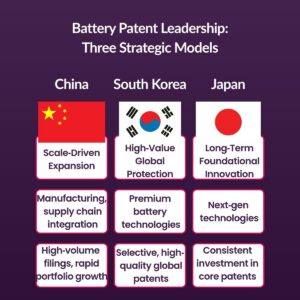
These differences are not just national characteristics; they represent fundamentally different strategic models for using intellectual property to secure leadership. To better understand how China, South Korea, and Japan are shaping the competitive landscape, their approaches can be distilled into three distinct models of battery patent strategy. Each reflects a different balance between scale, value, and long-term technological control.
|
Country
|
Strategic Model
|
Core Focus
|
IP Approach
|
Competitive Advantage
|
Key Risk
|
|---|---|---|---|---|---|
|
China
|
Scale-Driven Expansion
|
Manufacturing, supply chain integration
|
High-volume filings, rapid portfolio growth
|
Speed, breadth, ecosystem control
|
Patent quality variation, enforcement limits
|
|
South Korea
|
High-Value Global Protection
|
Premium battery technologies
|
Selective, high-quality global patents
|
Strong enforcement, licensing leverage
|
Exposure to litigation, high R&D cost structure
|
|
Japan
|
Long-Term Foundational Innovation
|
Next-generation technologies (e.g., solid-state)
|
Deep, consistent investment in core patents
|
Early control of future technologies
|
Slower commercialization, reduced presence in current-scale markets
|
The Next Patent Battlefield: Solid-State Batteries
Solid-state batteries represent the next frontier in battery innovation, offering improvements in energy density, safety, and charging performance.
While Japan leads in solid-state battery patents, China and Korea are rapidly closing the gap, setting up what could become the next major IP battleground.
This helps position the topic as an emerging “conflict zone” rather than just a trend. At the same time, companies are targeting commercialization timelines around 2027–2028.
The ability to both innovate and scale these technologies will likely determine the next phase of industry leadership.
Strategic Implications for Battery Companies
The divergence in patent strategies across China, South Korea, and Japan is increasing complexity for industry players.
As patent portfolios expand across key technologies, companies are likely to face greater complexity in licensing negotiations, particularly when entering new markets or adopting advanced chemistries. This makes it critical to understand not just who holds patents, but also how those portfolios overlap across the value chain, which requires robust technology landscaping and patent intelligence capabilities.
Entering new battery markets without a clear freedom-to-operate (FTO) strategy is becoming increasingly risky, as overlapping patent portfolios and aggressive filings raise the likelihood of licensing pressure and disputes.
In this environment, cross-licensing and strategic partnerships are becoming essential. Companies that can effectively combine innovation with a strong IP strategy will be better positioned to compete globally.
Three Distinct Paths to Battery Leadership
China, South Korea, and Japan each represent a different model of battery leadership.
- China has built scale-driven IP aligned with manufacturing dominance
- South Korea has focused on high-value, globally enforceable innovation
- Japan continues to lead in deep, next-generation research
There is no single path to leadership, but as competition intensifies, control over intellectual property will play a defining role in shaping the future of the global battery industry.
Talk to One of Our Experts
Get in touch today to find out about how Evalueserve can help you improve your processes, making you better, faster and more efficient.