
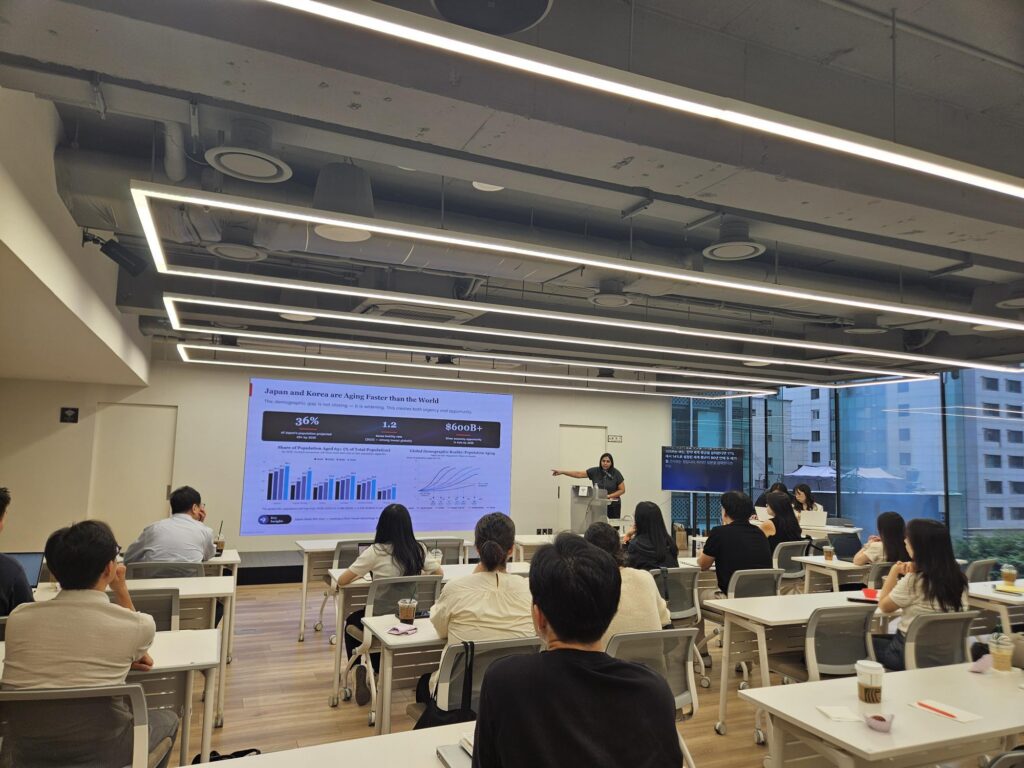
The rules of growth in consumer goods are being rewritten. On July 2, executives from leading Korean companies gathered in Seoul for Evalueserve's Problem-Solving Seminar Series, focused on how food and consumer goods companies can compete in an era of structural demographic change.
The session was delivered by Aarti Yadav, Head of Consumer Goods and Chemicals Practice, with regional context provided by Cheongim Seong, Client Director for Japan Market, and facilitated by Sara Jeon, Head of Sales for the APAC region. The central message was clear: portfolio strategies built for a younger, growing consumer base will not hold. The companies that adapt now, before the structural shift fully arrives, will define the next generation of category leaders.
It is not about whether we have growth targets. It is about whether our strategy is built for the consumer base that actually exists — and the one that is coming.
Aarti Yadav · Head of Consumer Goods and Chemicals Practice, Evalueserve
Why demographic change is a strategic inflection point
Japan has already entered the era that Korea is approaching. Population aging, household contraction, and slowing volume growth are structural, not cyclical. Yet most consumer goods portfolios were designed around a different consumer: younger, spending for a growing household, oriented toward value and convenience.
The seminar drew on Japan’s experience as a forward signal. Japanese companies have spent a decade recalibrating — toward functional and health-oriented products, smaller pack formats, premiumization, and entirely new category definitions built around the needs of older, higher-spending consumers. The insight for Korean executives: the transition is learnable, but it requires starting before the pressure becomes acute.
Four themes that define the new growth agenda
The session examined how leading CPG and F&B companies are responding to demographic-driven change across four interconnected themes.
1. Rethinking the portfolio for a new consumer base
Products designed for growing families and young households are seeing declining sales volume as demographics shift. The opportunity lies in active repositioning — not just adding “senior-friendly” SKUs, but redesigning core portfolio logic around functional value, health outcomes, and the spending priorities of consumers over 50.
2. The silver economy as a structural growth engine
The silver economy is often treated as a niche trend. The seminar argued that it is the primary structural growth driver available in mature markets. Functional foods, nutraceuticals, convenience formats for smaller households, and premium health propositions are already generating significant revenue in Japan — and the same category dynamics are emerging in Korea.
3. Adjacent categories and geographies
As domestic volume plateaus, the question of where to grow becomes urgent. The session addressed how companies can identify adjacent-category opportunities with structural momentum — and which international markets offer genuine relevance rather than complexity for its own sake.
4. Connecting intelligence to R&D and product transformation
Market intelligence is only useful when it drives decisions. A core theme was how to close the gap between consumer and competitive insight on one side, and R&D prioritization and product development on the other — building repeatable processes rather than one-off studies.

How Evalueserve approaches consumer goods strategy
Evalueserve integrates competitive intelligence, consumer research, and innovation analysis into a unified strategic picture — connecting what is happening in the market to decisions about portfolio, product, and growth model. The seminar demonstrated this through category case examples, showing how insight moves from trend identification to structured strategic action.
Key capabilities highlighted during the session:
- Demographic demand modeling — understanding how category consumption shifts as populations age
- Silver economy opportunity mapping — identifying where functional and health-oriented innovation is gaining commercial traction
- Portfolio gap analysis — assessing how current product lines align with where demand is heading
- International market screening — evaluating adjacent geographies for structural fit, not just market size
- R&D-to-market intelligence integration — ensuring product development decisions are grounded in competitive and consumer reality

Key takeaways
- Demographic contraction is structural, not cyclical — portfolio strategy must reflect this
- Japan offers a concrete, transferable model for navigating post-growth consumer markets
- The silver economy is a primary growth driver in mature markets, not a niche segment
- Functional foods, premiumization, and health propositions are where category momentum is concentrating
- Intelligence must connect directly to R&D and product decisions to generate business value
- International expansion requires structural fit analysis, not only market-size screening
What comes next
Upcoming in the series
The seminar series continues later in the year. Executives who wish to explore specific topics further — including portfolio transformation, silver economy opportunity mapping, or Japan market strategy — are invited to connect with the Evalueserve team for a follow-up consultation.
Experts from Evalueserve

Cheongim Seong
Client Director, Japan Market,
Cheongim.Seong@evalueserve.com

Aarti Yadav
Head of Consumer Goods and Chemicals Practice

Sara Jeon
Head Of Sales, APAC region, Sara.Jeon@evalueserve.com
For a deeper look at the themes covered in this seminar, explore our latest blogs on demographic change, the silver economy, and consumer goods growth strategy
