Open Gateway and CAMARA and the Race to Become the Default Network Capability Layer
Telecom’s next growth wave will not be driven solely by spectrum or coverage. It will be shaped by how easily developers and enterprises can consume network capabilities as APIs across operators and markets.
This shift mirrors what has already happened in cloud, payments, and mobile ecosystems. Infrastructure providers that exposed capabilities through APIs did not just create new products. They built platforms. Over time, value concentrated not in the infrastructure itself, but in the layers that controlled developer access, distribution, and trust.
Telecom is now entering that phase.
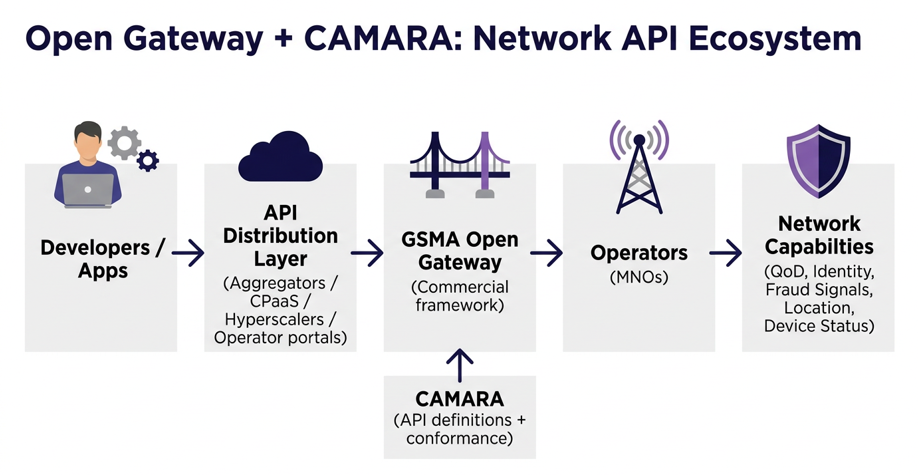
That is the strategic intent behind GSMA Open Gateway, a framework designed to expose operator capabilities through standardized APIs. A key design principle is that Open Gateway Service APIs are defined within the CAMARA project.
For leadership teams, the question is not whether APIs are useful. It is:
Who will own the distribution layer and capture the value across operators, aggregators, and hyperscalers?
What is Open Gateway, and what is CAMARA
Open Gateway
Open Gateway is a GSMA-led initiative that makes operator capabilities accessible through a common API, with a focus on interoperability and commercial adoption.
CAMARA
CAMARA is a Linux Foundation open source project that defines, develops, and tests telecom APIs, working in alignment with GSMA’s Operator Platform Group.
A practical way to understand the relationship:
- CAMARA builds API definitions and reference implementations
- Open Gateway drives commercial adoption across operators and ecosystems.
To make this tangible, consider a financial services onboarding flow. An application can call network APIs to verify whether a SIM has been swapped recently, validate device ownership, and request higher network reliability during a critical transaction.
The value is not in the API call itself. It sits in the trust, assurance, and performance behind it.
Why is this trending now?
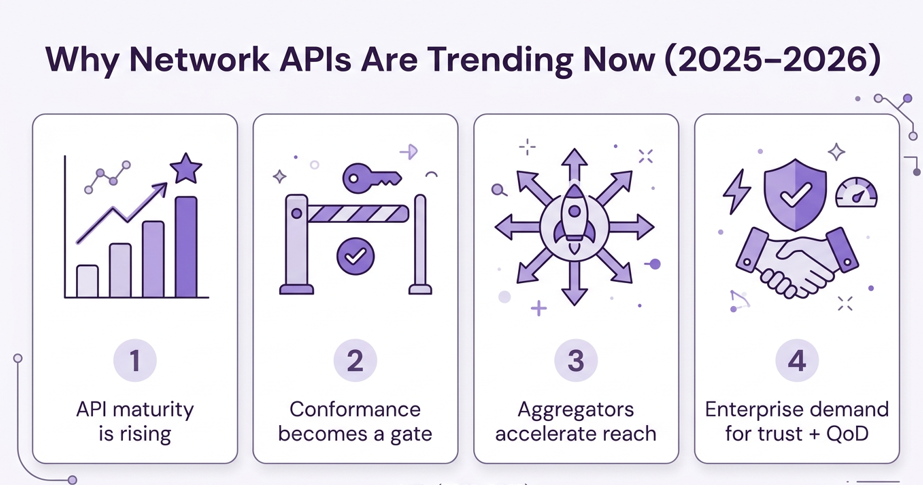
1) API maturity is accelerating
CAMARA’s Spring25 meta release signals a shift from experimentation to scale, with a growing set of stable APIs and a clear development pipeline.
As APIs mature, the focus shifts from building capabilities to distributing and monetizing them effectively.
2) The industry is converging on conformance
TM Forum and GSMA are advancing a unified approach to conformance certification, ensuring that CAMARA Service APIs and TM Forum Operate APIs align with Open Gateway standards.
Conformance reduces integration friction and builds ecosystem trust. It becomes a prerequisite for scale.
3) Aggregators are emerging as the fastest route to market
Platforms such as Aduna highlight the rise of multi-operator commercialization layers that combine and expose network APIs through a unified interface aligned with CAMARA and Open Gateway.
When a single integration layer becomes the easiest entry point, it begins to shape developer behavior, pricing expectations, and ecosystem structure.
The strategic risk is clear. Operators can lose control of the customer relationship and end up supplying capabilities on another platform.
Taken together, these signals point to a structural transition.
The industry is moving from building APIs to competing on how those APIs are distributed and monetized.
The questions leadership teams are asking.
Who will own the API distribution layer?
Operators aim to retain direct enterprise relationships.
Aggregators and CPaaS providers aim to become the default entry point for developers.
Hyperscalers aim to embed network APIs into cloud-native workflows.
This is unlikely to produce a single dominant player. However, most of the value will concentrate with those who control the workflows that developers depend on.
What becomes commoditized and what remains differentiated
Standardization will commoditize access to basic capabilities. Differentiation shifts into higher value layers, such as:
- quality of service enforcement
- identity and fraud decisioning
- consent governance and assurance
- observability and analytics
- ecosystem packaging and developer experience
As standard APIs expand, pricing pressure increases on basic access. Premium value concentrates in capabilities that directly influence revenue, risk, and user experience.
Where are the control points emerging
The most commercially relevant API domains include:
- Quality on Demand
- identity and verification
- fraud detection signals such as SIM swap checks
- device and location intelligence
These domains sit directly within high-value enterprise workflows.
A broader pattern is emerging. Value will not distribute evenly across the ecosystem. It will focus on a small set of control points, including distribution, trust, performance, and interoperability.
Why is this difficult to execute
1) Interoperability remains complex in practice
Even with standardization, real-world implementations vary across operators in semantics, latency, authentication, and error handling.
Conformance reduces friction, but variability remains.
2) SLA and liability expectations are rising
When APIs are used for fraud prevention or high-value transactions, best effort is not sufficient. Enterprises expect predictable SLAs, auditability, and clear dispute resolution.
Platform governance becomes a source of competitive advantage.
3) Commercial alignment lags technical readiness
Standardizing APIs is faster than aligning pricing models, settlement structures, customer ownership, and liability frameworks.
This gap reinforces why the distribution layer is a critical battleground.
In practice, technical standardization alone will not determine winners. Execution across interoperability, assurance, and commercial alignment will define which platforms scale and which remain interchangeable.
That distinction raises a more strategic question. If value concentrates around a limited set of control points, how should organizations position themselves to capture that value rather than supply into it?
In an upcoming piece, I will explore how these control points are forming across distribution, trust, performance, and developer ecosystems, and why they create both opportunity and lock-in risk. I will also look at what this means for IP and product leaders designing portfolios in a standardized API environment, where the real challenge is not participation, but defensibility.
Talk to One of Our Experts
Get in touch today to find out about how Evalueserve can help you improve your processes, making you better, faster and more efficient.