The Unbreathable Air and the Search for a Real Solution
India is facing a public health emergency so severe that the average citizen inhaled particulate matter equivalent to smoking 796 cigarettes in 2024. That same year, the country was ranked the third most polluted in the world. Current policies, such as the static Graded Response Action Plan (GRAP), and symptom-focused solutions, such as smog towers, have failed to deliver clean air. There can be a new transformative approach to solving this problem: an AI-powered system designed not just to charge polluters, but to predict and prevent pollution from forming in the first place. Here are the most impactful takeaways from this proposed solution.
To move beyond short-term fixes, India needs a system that identifies the conditions that create pollution spikes well before they occur—something traditional policy tools were never designed to do.
It's Not a Ban, It's a Smart, Dynamic Toll
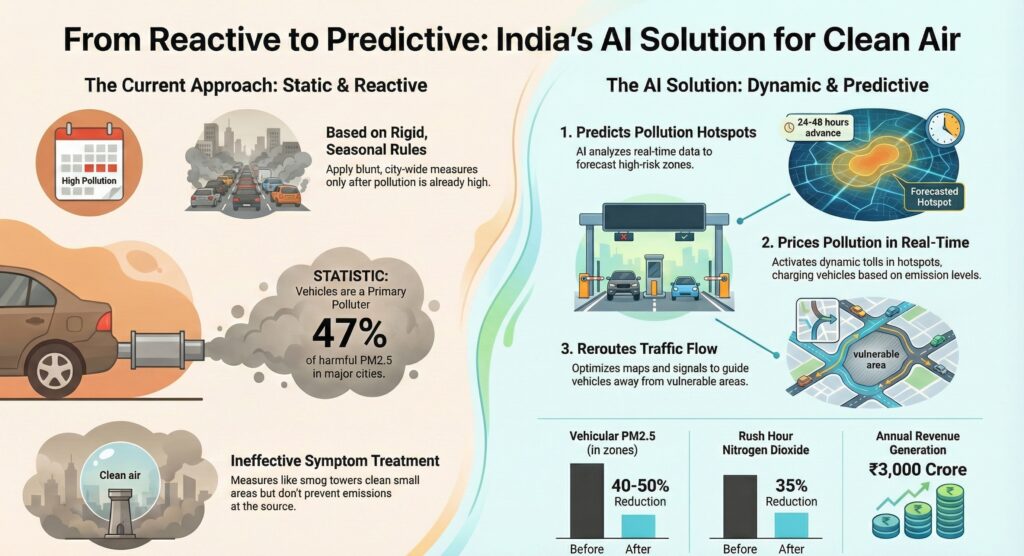
The core of the system is the concept of "dynamic emission zones." Using data from air quality monitoring stations, weather forecasts, and traffic flows, an AI model can predict pollution hotspots 24 to 48 hours in advance. These forecasts rely on spatiotemporal machine learning models that simulate how emissions interact with meteorology—temperature inversions, wind stagnation, humidity, and roadway density—to pinpoint when and where toxic buildup is likely. When the system forecasts a dangerous buildup of pollutants in a specific area, it can activate a geofenced zone and charge vehicles based on the real-time pollution risk they pose. For example, a BS-IV diesel might be charged ₹500 to enter a hotspot during a winter temperature inversion, but nothing at all on a windy summer day. Meanwhile, electric vehicles and compliant BS-VI cars would always have free passage.
But this system can do more than charge polluters; it can also proactively manage traffic. It may intelligently reroute vehicles in real-time through digital infrastructure—updating Google Maps, traffic signals, and electronic road signs to disperse traffic and prevent hotspots from forming. This dynamic orchestration allows the system to intervene before congestion concentrates emissions, turning the city’s transportation network into an adaptive environmental control mechanism. This may transform the system from a simple financial tool into a sophisticated, real-time urban management platform. It creates precise economic incentives, making polluters pay in direct proportion to the environmental harm they cause, while simultaneously optimizing traffic flow to improve air quality.
It Builds on the Technology India Already Has
This high-tech proposal doesn’t require building massive new physical infrastructure from scratch. The system can be a masterclass in software-based policy, weaving together three of India’s landmark digital infrastructures:
- Aadhaar for vehicle identification.
- FASTag for seamless, automatic tolling.
- The national network of air quality monitoring stations for real-time data.
You could read more details here: Clean Air Research Initiative (CARI) | Department Of Science & Technology
Because the system relies on software integration and upgraded cameras rather than new highways or toll plazas, it may be deployed relatively quickly—potentially within 18 months. A phased rollout may be envisioned, starting with a pilot in the most polluted districts of the Delhi NCR before scaling nationally.
India’s successful digital transformations—UPI, FASTag, and DigiYatra—prove that large-scale behavioral-change systems can be implemented rapidly when built as digital public goods. This proposal follows that same architectural philosophy: low hardware, high intelligence, and massive scalability.
It's a System That Pays for Itself
The proposed model includes a self-financing mechanism where the cure pays for itself. Revenue from dynamic tolling may be earmarked to directly fund public transit improvements and electric vehicle subsidies, creating a virtuous cycle. This concept is grounded in proven models. London's similar congestion charge reduced traffic by 30% and raised £200 million annually for public transport. Projections for India are significant: a pollution-adjusted version in Delhi alone could generate ₹1,500 crore yearly, while major metros combined could raise ₹3,000 crore annually for investment in cleaner transit options.
Even under conservative scenarios—based on current vehicle mix, compliance rates, and FASTag penetration—revenues remain strong enough to fund metro expansions, electrification of bus fleets, and targeted air quality initiatives. This makes the system politically attractive, financially feasible, and socially progressive.
The architects of the proposal summarize its transformative potential in a single, powerful statement:
The single most transformative solution for India's air quality crisis is an AI-Powered Dynamic Emission Zoning & Traffic Management System that uses real-time pollution data, predictive meteorological modeling, and adaptive tolling to manage vehicular emissions where and when they cause the most significant harm.
It Finally Switches from Reactive to Predictive
Current solutions like smog towers and "WAYU" air purification devices are fundamentally reactive; they attempt to clean the air after it has already become dangerously polluted. They treat the symptom, not the cause. The AI-powered system is predictive. By forecasting pollution spikes, it can apply tolls and reroute traffic before a hotspot becomes critical. Unlike traditional, static source apportionment studies that offer a fixed snapshot of pollution, this AI system updates hourly. This allows it to recognize and respond to dynamic, real-world events, such as the synchronized spikes in multiple pollutants during the morning rush hour, in ways current policies cannot.
Predictive modeling also eliminates long-standing debates about blame—whether traffic, weather, or industrial emissions are responsible—because each spike is logged with real-time attribution. This significantly improves transparency for policymakers and strengthens the legitimacy of enforcement.
Furthermore, the system's continuous data collection would finally end long-standing debates about pollution sources by showing precisely what combination of factors—from traffic to weather—drives each pollution spike. Modeling suggests this predictive approach could reduce vehicular PM2.5 by 40–50% in activated zones and cut city-wide PM2.5 by 15–20%.
Over time, this dataset becomes a national asset—supporting everything from urban planning to climate adaptation to evidence-based policy design.
A Digital Solution for a Public Health Crisis
Ultimately, the proposal argues that India can solve its air pollution crisis by applying the same technological intelligence it used to build its world-class digital payment and identity systems. The country faces a choice: continue perpetually treating the symptoms of a public health crisis, or deploy a digital public good for clean air—applying the nation's proven tech genius to its most vital resource.
India doesn’t need another smog tower—it requires a smarter system. By turning predictive AI into a public good, we can transform the fight against pollution from a reactive struggle into a proactive solution. The question is no longer, Can we do this? It’s how soon will we choose to?
The first step is clear: launch a regulatory sandbox and a Delhi-NCR pilot, bringing together the pollution control board, NITI Aayog, AI experts, and mobility platforms. With the proper mandate, India could operationalize a working version of this system in under two years—setting a global benchmark for how technology can protect public health at a national scale.
Talk to One of Our Experts
Get in touch today to find out about how Evalueserve can help you improve your processes, making you better, faster and more efficient.